Website traffic but no leads? Read your own sentences first
· 7 min read
Your analytics show people arriving. Your inbox shows nobody writing. So you look up why, and every article gives you the same list: page speed, trust badges, a bigger button, fewer form fields.
Those can matter. But they skip the first thing every visitor actually does on your page, which is read it. If the sentences on the first screen don't give a stranger a reason to act, a faster page just lets them leave sooner.
So this post does something the usual lists don't. It goes through one real homepage sentence by sentence, and shows which lines lose the visitor and why. The page is ours.
We ran Klarnio, our website audit, on klarnio.com on 28 September 2026. Our own copy scored 42 out of 100. Every quote below is taken word for word from that page and that audit, including the parts that are embarrassing.
Step 1: Read only what a first-time visitor reads
A visitor decides on the first screen, before they scroll. Open your homepage in a private window, on your phone, and read only what's visible. Ignore what you know about your business. Read it as a stranger who arrived from a search, with something else to do.
Here is what our first screen said:
Your website has 30 seconds to say something worth acting on.
Klarnio reads your page the way a first-time visitor does, then shows you the exact sentences to change.
The second sentence is fine: you can picture it, and it's true of our product. The headline is the problem, and the three tests below show why.
Step 2: Run three tests on every sentence
You can run these in your head, on any sentence, in about ten seconds each.
Test 1: Can the visitor picture it?
A sentence that can't be pictured doesn't get remembered. Read the line, close your eyes, and see whether anything appears.
Our closing headline failed this one:
"You have read enough about it."
Nothing to see, and nothing to do. The audit's rewrite:
"Paste your URL and read the three sentences on your own homepage a visitor will not act on."
Same length, same place on the page. But now there's a picture: your own page, three of your own sentences on screen. A visitor can see what happens if they act.
Look for: headings like "Why choose us", "Our approach", "Quality you can trust", "Let's work together". They name a topic, not something to picture.
Test 2: Could anyone prove it wrong?
If nobody could ever show a claim to be false, it says nothing. "Fast delivery" can't be wrong. "Installed in 4 days or it's free" can.
Our homepage passed this test in one place:
"Klarnio starts at 20 EUR a month and takes two to three minutes."
A price and a time. Anyone can check both.
And it failed it in the line that sits under the "problem" heading:
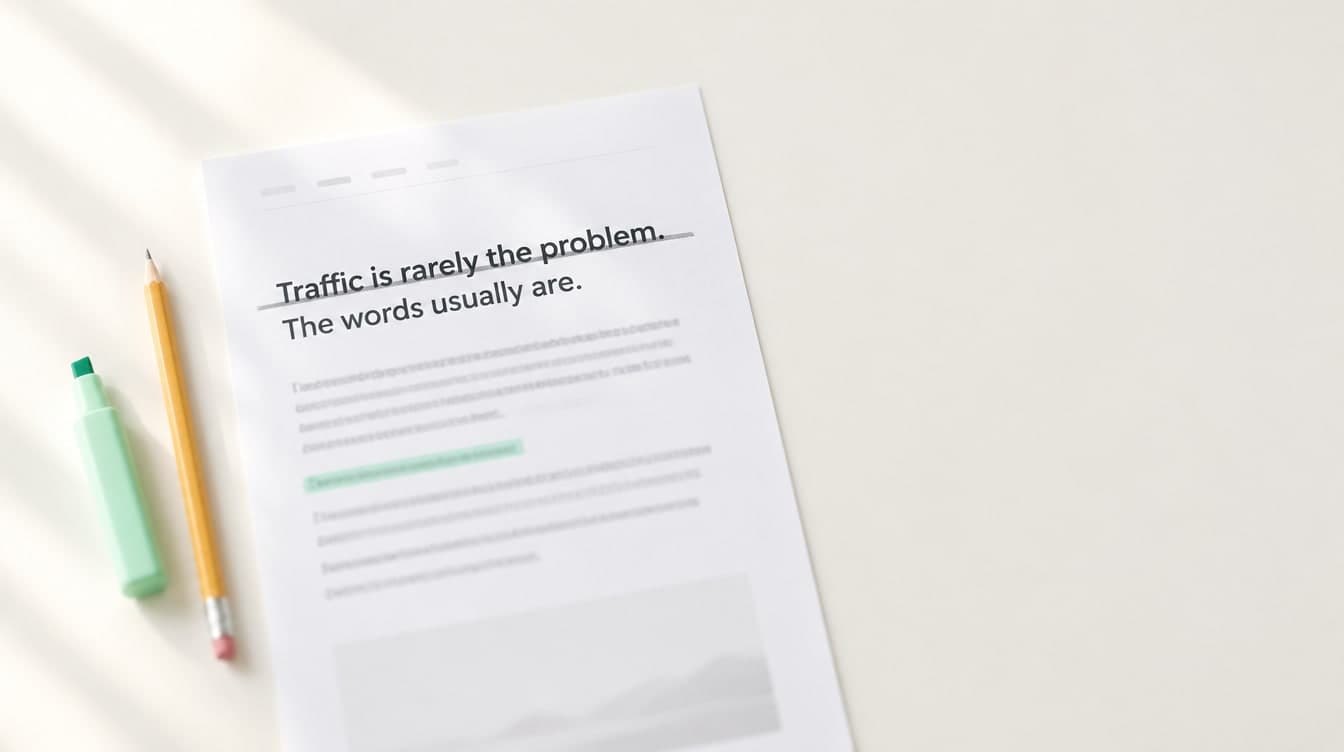
"Traffic is rarely the problem. The words usually are."
Rarely according to whom? Usually out of how many? We believed it when we wrote it, but nobody reading it can check it. Here is the audit's rewrite:
"Of the NUMBER pages audited so far, NUMBER lost the reader on the words, not the traffic."
Notice the blanks. Our page didn't state those numbers, so the audit didn't invent them. It left a marked gap for us to fill from real records.
This is the most useful habit to steal from this post. When a sentence needs a number you don't have, leave a visible blank and go and count. A made-up statistic on your homepage is worse than a vague one: the first visitor who checks it stops believing everything else on the page.
Look for: "most", "many", "often", "leading", "trusted by businesses", "industry-leading", "hundreds of happy customers". Each needs a count, a name or a date, or it should go.
Test 3: Could only you say it?
Imagine your competitor's logo at the top of your homepage. If the sentence still works, it isn't yours.
Ours failed in the section about checking a page again after fixing it:
"Fix it, audit it again, see what moved."
Every audit tool on the internet lets you run it again. A visitor learns nothing about us. The rewrite:
"Re-audit the same page and your old scores stay on screen beside the new ones."
That's specific to how our report works, and a visitor can picture the two scores side by side.
Look for: "We help businesses grow", "Solutions tailored to your needs", "Your trusted partner", "Quality service at a fair price". If a competitor could paste the sentence onto their own site and nothing would change, the visitor has no reason to choose you.
Step 3: Check the three questions every visitor brings
Sentences are half of it. The other half is whether the page answers what the visitor came with. Every first-time visitor is quietly asking three things, in this order:
- Is this about my problem? Does the page name the situation I'm in, what triggered my search today, and what it's costing me?
- Can I trust it? Is there a price, proof, the risk taken away, and an obvious next step?
- What happens after I say yes? What do the first days look like, who helps me when I'm stuck, and what does success look like in a few months?
The audit scores each of these out of 100. Ours:
Is this about my problem? (Struggle)
50
What the audit found
"No consequence in money, time or risk. The problem section proves the sentences are weak but never says what weak sentences cost, so the visitor has no reason to act before next quarter."
Can I trust it? (Evaluation)
100
What the audit found
Price, what's included, proof, risk removed, a comparison and a clear next step are all on the page.
What happens after I say yes? (Growth)
50
What the audit found
"Nothing describes life after the first report."
The middle row is the one most "traffic but no leads" advice focuses on: trust badges, testimonials, a clearer button. Our page already had all of that, and it still lost half its points elsewhere.
The first row is where an enquiry dies quietly. Our page never told the visitor what bad sentences are costing them, so even someone who agreed with every word had no reason to act today rather than next quarter. The audit also flagged that the page spoke to four audiences at once: site owners, freelancers, LinkedIn posters and agencies. When a page is written for everyone, nobody recognizes themselves on the first screen.
The 10-minute self-check
Do this on your own homepage before you spend money on traffic or a redesign:
- Open the page in a private window on your phone. Read only the first screen.
- Write down every sentence on it, including the button text and the small print under it.
- Picture test. Next to each sentence, write what you see when you read it. If nothing comes to mind, mark it.
- Proof test. Circle every "most", "many", "best", "trusted", "leading" and "quality". Replace each with a number, a name or a date you can show, or leave a visible blank and go and count.
- Logo test. Cover your logo. Could a competitor say each sentence? If so, mark it.
- The three questions. Does the first screen name your visitor's situation and what it costs them? Is there a price, proof and a next step? Does anything say what happens after they get in touch?
- Pick one reader. If your first screen speaks to several kinds of customer, choose the one who matters most this quarter and rewrite the first screen for them alone.
Most pages have three to five marked sentences on the first screen. Those are the ones to rewrite first, before you change the colors or buy more ads.
Frequently asked questions
Is low conversion always a copy problem?
No. Broken forms, a slow page on mobile or the wrong traffic can all stop enquiries. But copy is the cheapest to check and the cheapest to fix, and it's the thing most diagnostic tools never read. Check it first, then rule the rest out.
Should I put statistics on my homepage?
Only ones you can show the source for. A real number with what it counts and when ("NUMBER kitchens fitted in 2025") beats a vague claim. An invented one ("trusted by thousands") is worse than both. When you don't have the number yet, write the sentence with a blank and go and count.
How is this different from an SEO audit?
An SEO audit asks whether Google can read your page. This asks whether a person who has never heard of you would act on what it says. A page can rank well and still say nothing worth acting on.
Run the same tests on your page
You can do everything above by hand in about ten minutes. Or paste your URL into Klarnio and it reads your page the way a first-time visitor does: it quotes your own sentences back to you, marks the ones that fail, and shows what to say instead. Where a rewrite needs a number your page doesn't give, it leaves a blank rather than inventing one.
It's free, needs no account, just your email, and takes two to three minutes.